The drain field is the part of your septic system you never see — until it fails. When a field stops absorbing, effluent surfaces in the yard, sewage odors rise, drains slow throughout the house, and the lush green stripe over the field lines tells the whole story. A failed drain field is the most expensive septic problem there is, which is exactly why the diagnosis has to be right.
We diagnose drain fields honestly: load testing to measure actual absorption, probing to check for biomat clogging versus structural failure, and camera inspection of the distribution lines. Some fields can be rejuvenated — resting a section, jetting the lines, correcting distribution — while others are truly done and need replacement or relocation. We'll tell you which one you're looking at, with evidence.
If your yard is soggy, smells, or shows the telltale green stripes over the field, call. A field in early failure is sometimes salvageable; a field that's been failing for a year usually isn't. Time matters.
Signs your drain field is failing
- Soggy ground or standing water over the drain field area
- Sewage odors in the yard, especially after rain or heavy water use
- Unusually lush, dark green stripes of grass over the field lines
- Slow drains throughout the house that pumping didn't fix
- Effluent visibly surfacing in the yard
How we handle drain field problems
1 Test absorption honestly
We load-test the field to measure how it's actually absorbing under real flow — not a guess, a measurement. This tells us whether the field is clogged, undersized, or structurally failed.
2 Find the failure mode
Biomat clogging from skipped pumping is different from a crushed line or a field built in unsuitable soil. We probe and camera the lines to identify the actual failure mode, because each has a different fix.
3 Repair what can be repaired
Correctable problems — uneven distribution, root-blocked lines, a section that needs resting — get repaired. If the field is genuinely at end of life, we tell you straight and design the replacement for your soil and county requirements.
4 Protect the new field
Whether repaired or replaced, we set you up with the maintenance schedule that keeps it alive — pumping intervals, water-use guidance, and what not to plant or park over the field.
Drain fields in Schertz's shallow soils
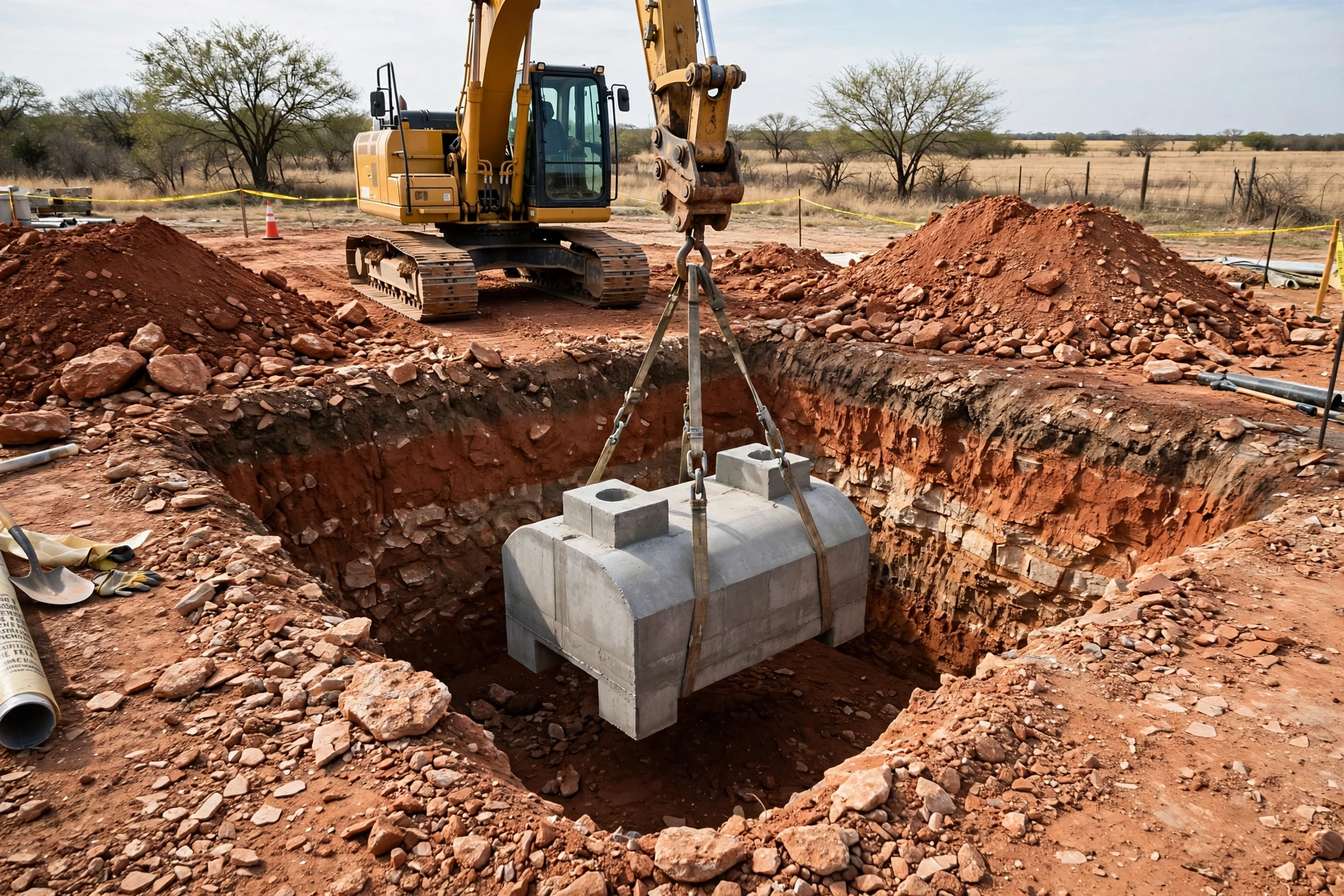
Schertz's drain fields live in some of the toughest soil in the corridor: shallow caliche and limestone with thin soil cover over rock, plus expansive clay that shifts with the seasons. A field that would last 30 years in deep sandy loam can struggle here — marginal soil depth means less absorption capacity, and rock near the surface limits where effluent can go. Many older fields were installed before current Guadalupe County standards tightened, in soils that wouldn't be approved today. That's why field failures are common here and why the replacement has to be engineered for the actual ground — soil evaluation, proper sizing, and often an aerobic or alternative system where conventional won't work. We design for Schertz's ground, not a textbook's.
Need drain field repair in Schertz?
No forms, no waiting — one call connects you with a local technician.
(555) 123-4567 📞 Call Now